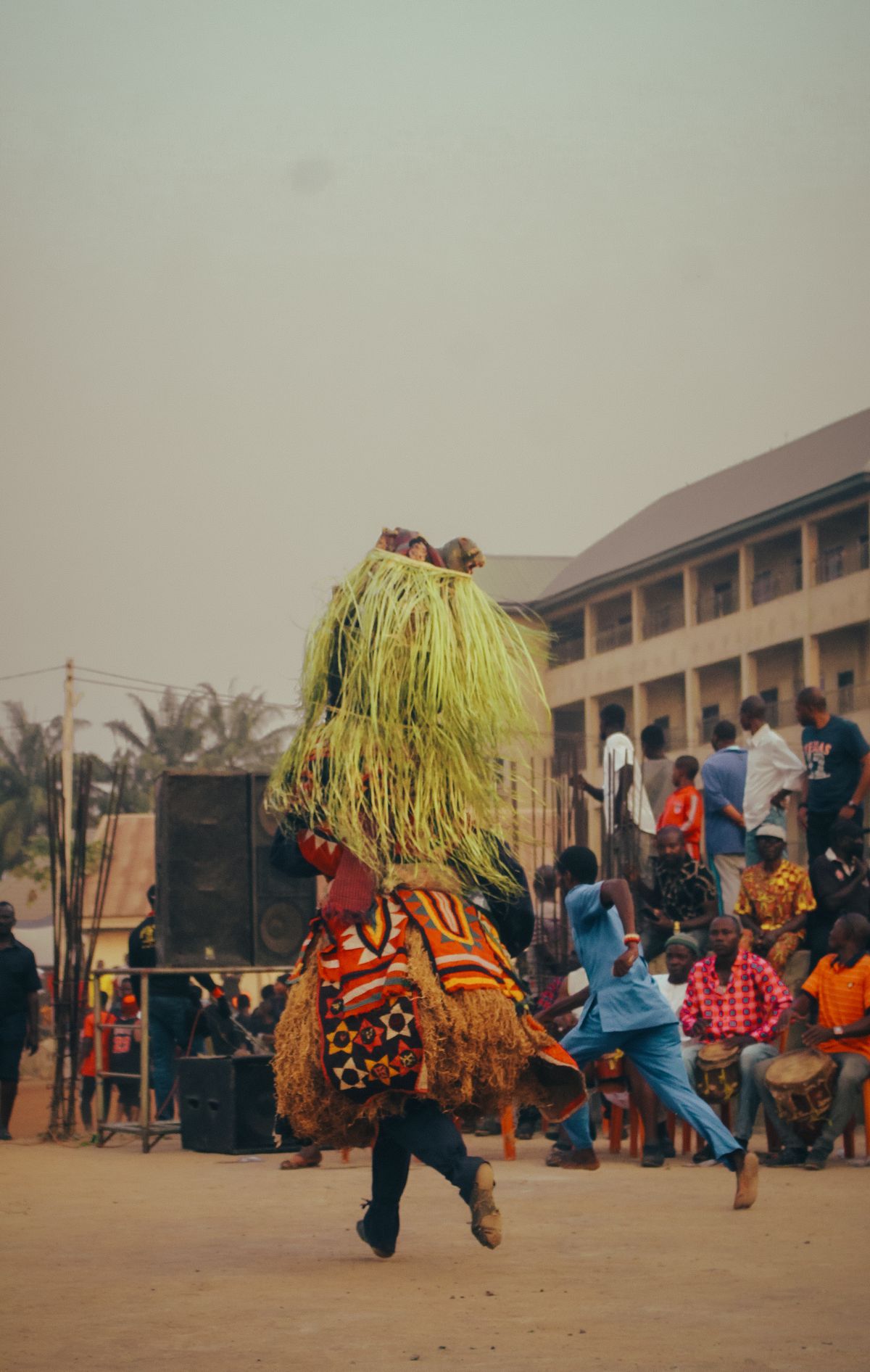
UNESCO-recognised and shrouded in secrecy, the Nyau (Gule Wamkulu) society of the Chewa people blends masks, spirits, and social commentary. Discover how this Tete and Niassa tradition connects to African American masking heritage.
Nyau: The Secret Dance Society of the Chewa
The Masked Spirits of the Plateau
In the highland plateaus of Tete and Niassa provinces, where the Mozambican landscape rises toward the Malawi border, a tradition persists that is older than colonialism, older than the nation-state, and — its practitioners would argue — older than memory itself.
The Nyau (also known as Gule Wamkulu, "the great dance") is a secret society practiced by the Chewa people. In Mozambique, Chewa communities in Tete and Niassa maintain the tradition, which UNESCO inscribed as Intangible Cultural Heritage of Humanity in 2005.
Nyau is not merely a dance. It is a complex cosmological system — a means of communicating with the spirit world, enforcing social norms, initiating young people into adulthood, and maintaining the delicate balance between the living and the dead.
The Secret
The word "secret" is used deliberately. Nyau knowledge is restricted to initiated men. The meaning of masks, the choreography of dances, the content of songs, and the cosmological framework that underpins the tradition are all closely guarded. Non-initiates — including women, children, and outsiders — see the performance but do not understand its full meaning.
This secrecy is not about exclusion for its own sake. It is a mechanism of cultural preservation. In a world where African traditions have been systematically studied, documented, and commodified by outsiders, the Nyau's insistence on secrecy is a form of resistance — a way of maintaining control over sacred knowledge.
The Masks and Characters
Nyau performances feature a range of masked characters, each representing different aspects of Chewa cosmology:
- Animal spirits — elephants, antelopes, wild boars, and composite creatures that exist only in Chewa spiritual cosmology. These full-body costumes are often enormous, requiring the performer to embody the animal's movement and energy.
- Human characters — including caricatures of colonial figures, politicians, and community types (the drunkard, the gossip, the miser). These characters serve as social commentary, gently (or not so gently) mocking antisocial behaviour.
- Spirit beings — representations of ancestors and supernatural forces, often the most elaborate and frightening masks.
Each character has a specific dance, specific drum rhythms, and a specific role in the performance's narrative structure. The full performance — which accompanies funerals, initiation ceremonies, and important community gatherings — can last an entire day or more.
Nyau in Mozambique vs. Malawi
While the best-known Nyau traditions are in Malawi (where the Chewa are the majority ethnic group), Mozambican Nyau has its own character. In Tete province, the Nyau tradition incorporates influences from the Sena and Ndau peoples. In Niassa, it blends with the Yao cultural context. These local adaptations make Mozambican Nyau distinct from its Malawian counterpart.
The Mozambican civil war (1977–1992) severely disrupted Nyau traditions in rural areas, as communities were displaced and cultural practices were interrupted. Post-war reconstruction has seen a revival of Nyau in many communities, though the tradition remains under pressure from Christianity, urbanisation, and modernisation.
The American Connection
Nyau's connection to American audiences is complex and fascinating:
- African masking traditions in America: The Mardi Gras Indians of New Orleans, the Jonkonnu tradition of the Carolinas, and various Caribbean carnival traditions all derive from African masking practices. While these traditions originate primarily from West and Central Africa, the structural principles — mask as spirit vessel, performance as community teaching, anonymity as social commentary — are shared with Nyau.
- DanceAfrica and cultural festivals: While DanceAfrica 2025 focused on Mozambique broadly, the festival's celebration of masked dance traditions created space for dialogue between different African masking traditions.
- Academic interest: American anthropologists and African studies scholars have studied Nyau, though the tradition's secrecy means that published accounts are necessarily incomplete.
- Museum collections: Nyau masks are held in several American museum collections, including the Smithsonian, where they are studied and displayed.
A Tradition of Resistance
What makes Nyau particularly relevant in the American context is its tradition of resistance. Throughout the colonial period, Nyau performances incorporated characters that mocked European colonisers — a form of cultural resistance that allowed the Chewa to maintain dignity and identity under foreign rule.
This tradition of performance-as-resistance connects directly to African American cultural history — from the coded messages of slave spirituals to the political commentary of hip-hop. Both traditions use performance as a means of speaking truth to power, of preserving community identity under oppression, and of maintaining cultural continuity despite systematic efforts to erase it.