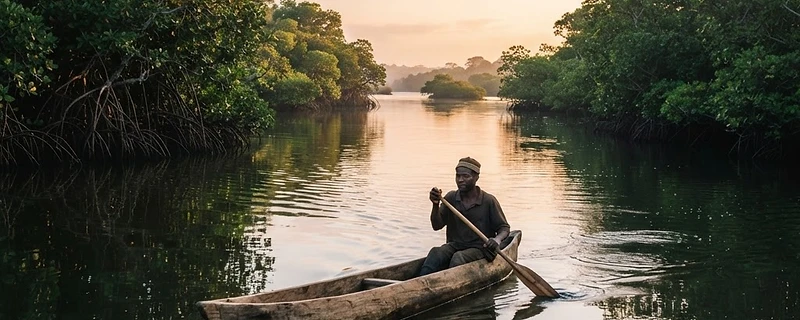
The Zambezi Delta is one of Africa's last great wetland wildernesses — 2,000 km² of channels, mangroves, and birdlife. Canoe through a world before maps.
A Delta That Breathes
The Zambezi River enters Mozambique at Zumbo, in the far west of Tete province, and travels 800 kilometres eastward. By the time it reaches the Indian Ocean, it has become something extraordinary: a vast, sprawling delta of channels, islands, mangroves, and floodplains that covers over 2,000 square kilometres. This is the Zambezi Delta — one of Africa's last great wetland wildernesses.
Unlike the delta's more famous cousins — the Okavango, the Niger — the Zambezi Delta remains almost entirely unknown to international tourism. There are no luxury lodges, no pontoon boats full of photographers, no carefully curated "delta experiences." What there is, instead, is raw, wild, and profoundly beautiful: a living landscape of water, birds, fish, and the communities who have called it home for centuries.
Canoeing the Channels
The only way to truly experience the delta is by canoe — the traditional dugout canoe, or mukolo, used by local fishermen. A canoe journey through the delta is a journey into silence: the dip of the paddle, the call of a fish eagle, the distant splash of a hippopotamus. The channels are narrow, roofed with mangroves, and open without warning into vast lagoons where crocodiles sun themselves on mudbanks.
The water is tea-coloured from the tannins of decomposing vegetation. The banks are thick with mangroves, papyrus reeds, and the occasional towering baobab. Fishermen in mukolos glide past, their silhouettes black against the golden water. They raise a hand in greeting and are gone.
A Birdwatcher's Paradise
The Zambezi Delta is one of the most important bird habitats in southern Africa. Over 400 species have been recorded here, including:
- African skimmer: An endangered species that nests on sandbanks in the delta's channels.
- Pel's fishing owl: A large, ginger-coloured owl that hunts fish at night — one of Africa's most sought-after birds.
- Wattled crane: Standing over 1.5 metres tall, these elegant birds feed in the floodplains.
- Palearctic migrants: From October to March, the delta fills with European and Asian migrants — ospreys, bee-eaters, sandpipers, and terns.
- African fish eagle: The delta's soundtrack — its piercing call echoes across the water from dawn to dusk.
For birders, the delta is a frontier. Species are still being documented here. You might see something no one has recorded before.
The Communities of the Delta
Several communities live within the delta, primarily Sena and Tonga people who have adapted to a life defined by water. Their villages are accessible only by boat. Their livelihoods depend on fishing, floodplain agriculture, and the collection of mangrove resources — crabs, shellfish, honey from mangrove flowers.
These communities are among the most isolated in Mozambique. No roads reach them. No electricity. No mobile network in many areas. But they are not poor in the ways that matter: they have deep knowledge of the delta's ecosystems, strong social structures, and a relationship with the river that is spiritual as much as economic.
Community tourism in the delta — in its early stages, facilitated by operators like Zambezi Delta Lodge — offers these communities an alternative income source that does not require the destruction of the wetlands they depend on. When a fisherman earns money guiding a canoe safari, he has an economic stake in the health of the river. That is conservation through economics.
A Delta Under Pressure
The Zambezi Delta faces real threats:
- Upstream dams: The Cahora Bassa Dam regulates the river's flow, reducing the seasonal floods that replenish the delta's floodplains and mangroves.
- Climate change: Rising sea levels threaten the mangrove fringe that protects the delta from the ocean.
- Deforestation: Mangrove cutting for firewood and construction is accelerating.
- Industrial agriculture: Sugar and rice plantations on the delta's edges encroach on wetland habitat.
The communities of the delta are the frontline. If they can earn more from protecting the wetland than from degrading it — through tourism, sustainable fishing, and carbon credits — the delta has a future. If not, one of Africa's last great wetlands will slowly die.
How to Visit
- Access: By boat from Quelimane (Zambezia's capital). The journey takes 4-6 hours depending on the channel.
- Best season: May to October (dry season — water levels lower, more channels navigable, fewer mosquitoes).
- Accommodation: Zambezi Delta Lodge (listed on nendeni.com, 50% community benefit).
- What to bring: Binoculars, sunscreen, a wide-brimmed hat, insect repellent, and a sense of wonder. This is not a curated experience — it is an expedition.
- Patience: Wildlife viewing requires patience. The delta reveals itself slowly.
A Place Before Maps
The Zambezi Delta is one of the last places in southern Africa where you can travel for days without seeing another tourist, without mobile signal, without a road. It is a place that resists the modern world's insistence on speed and convenience.
In the delta, you travel at the speed of a paddle. You eat what the river provides. You sleep to the sound of hippos. And slowly, the delta reveals itself — not as a destination, but as a living, breathing system that was here long before humans arrived and will be here long after we are gone.
That is worth travelling for.
Find ethical stays and delta experiences in Zambezia at nendeni.com.