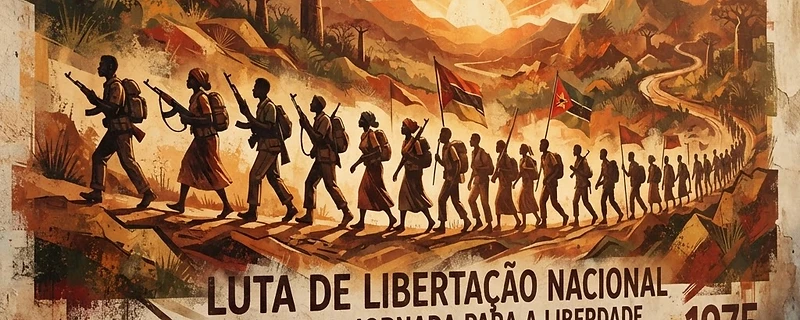
From FRELIMO's founding in 1962 to the Carnation Revolution and independence in 1975, here is the history of Mozambique's liberation struggle — and where to visit it today.
The Long Road to Freedom: Mozambique's Liberation Struggle
On June 25, 1975, Mozambique became an independent nation. The road to that day was long, bloody, and shaped by forces both local and global. Understanding this history is essential to understanding modern Mozambique.
The Colonial Context
Portugal claimed Mozambique from the early 16th century, but effective control over the territory was limited until the late 19th century. The prazo system — vast estates granted to Portuguese settlers and Afro-Portuguese families — dominated the centre and north. In the south, migrant labour to South African mines became the economic backbone.
Portuguese colonialism was distinctive in its refusal to acknowledge its own obsolescence. While Britain and France were preparing their African colonies for independence in the 1950s, Portugal under the Estado Novo dictatorship insisted that Mozambique, Angola, and Guinea-Bissau were "overseas provinces" — integral parts of Portugal that would never be granted independence.
This intransigence left armed struggle as the only path.
The Birth of FRELIMO
The Frente de Libertação de Moçambique (FRELIMO) was founded on June 25, 1962, in Dar es Salaam, Tanzania, through the merger of three existing nationalist groups. Its first president was Eduardo Chivambo Mondlane, a Mozambican from Manjacaze, Gaza province, who had been educated in South Africa, Portugal, and the United States (he earned a PhD from Northwestern University).
Mondlane was a remarkable figure — a scholar, an orator, and a strategist who understood that liberation required both military action and political education. He insisted that FRELIMO must not merely expel the Portuguese but build a new society in the liberated zones.
The Armed Struggle
FRELIMO launched its armed campaign on September 25, 1964, with coordinated attacks on Portuguese posts in northern Mozambique. The war would last ten years.
Key phases:
- 1964–1968: FRELIMO established liberated zones in Cabo Delgado and Niassa. These zones had their own schools, health clinics, and agricultural cooperatives — a blueprint for the future nation.
- 1969: Eduardo Mondlane was assassinated in Dar es Salaam by a parcel bomb — almost certainly the work of Portuguese secret police (PIDE). His death was a devastating blow, but FRELIMO did not fracture. Samora Machel succeeded him.
- 1970–1974: Under Samora Machel, FRELIMO expanded south and opened new fronts in Tete (near the Cahora Bassa dam construction). Portuguese military operations, including the notorious Operação Nó Górdio (1970) — the largest military operation in Portuguese military history — failed to destroy FRELIMO.
The Carnation Revolution
The turning point came not in Mozambique but in Portugal. On April 25, 1974, a military coup in Lisbon — the Carnation Revolution — overthrew the Estado Novo dictatorship. The new Portuguese government, led by the Armed Forces Movement, was committed to decolonisation.
Negotiations between Portugal and FRELIMO took place in Lusaka, Zambia, in September 1974. The Lusaka Accord was signed on September 7, 1974, setting a date for independence: June 25, 1975.
Independence and Its Aftermath
On June 25, 1975, the People's Republic of Mozambique was proclaimed. Samora Machel became the first president. His speech — "A vitória sempre foi e continuará a ser nossa" ("Victory was and will continue to be ours") — echoed across the new nation.
The challenges were immense:
- The mass exodus of Portuguese settlers (approximately 200,000 left within months), taking skills, capital, and infrastructure
- A hostile regional context — Rhodesia (now Zimbabwe) and apartheid South Africa viewed the new Marxist state as a threat
- The Rhodesian-backed RENAMO insurgency, which would become the Mozambican Civil War (1977–1992)
- Natural disasters, economic crisis, and the burden of nation-building under conditions of war
The Civil War
The Mozambican Civil War pitted FRELIMO (the government) against RENAMO (originally created by Rhodesian intelligence, later backed by apartheid South Africa). It was brutal: an estimated 1 million people died, 5 million were displaced, and infrastructure was devastated.
The war ended with the Rome General Peace Accords, signed on October 4, 1992. Multi-party elections followed in 1994, which FRELIMO won.
Samora Machel's Legacy
Samora Machel died on October 19, 1986, when his presidential plane crashed near Mbuzini, on the South African border. The cause remains disputed — some believe South African apartheid agents lured the plane off course with a false navigational beacon.
Machel's legacy is complex. He was a charismatic, visionary leader who inspired millions, but his government also made errors: forced villagisation, hostility to traditional religion, and economic policies that proved unsustainable. Yet his commitment to education, gender equality, and Pan-African solidarity left an indelible mark on Mozambican identity.
Visiting Liberation History
Travellers interested in this history can visit:
- The Eduardo Mondlane Statue, Maputo
- Samora Machel's Memorial, Mbuzini (near the South African border)
- The Museum of the Revolution, Maputo
- Independence Square (Praça da Independência), Maputo — where the Portuguese flag was lowered and the Mozambican flag raised
- Mueda, Cabo Delgado — site of the 1960 Mueda Massacre, a turning point in nationalist consciousness
The Lesson
Mozambique's independence was not given. It was taken — through ten years of armed struggle, decades of political organising, and the sacrifice of thousands of lives. Understanding this history is not about taking sides. It is about recognising that the Mozambique you visit today was forged in fire, and that its people carry that fire in their resilience, their creativity, and their determination to build a future worthy of the struggle.