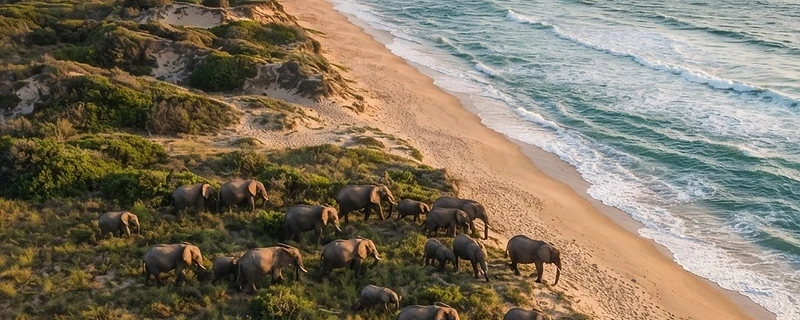
In Maputo Special Reserve, elephants traverse ancient corridors from inland forests to the Indian Ocean. Discover one of Mozambique's most extraordinary conservation success stories.
A Reserve Like No Other
Imagine elephants walking across white sand dunes, their tracks pressing into the beach where waves lap at their feet. This is not a dream — this is Maputo Special Reserve, one of the only places on Earth where elephants regularly traverse from inland forest to the Indian Ocean.
Formerly known as Maputo Elephant Reserve, this 1,040 km² protected area sits in the far south of Mozambique, just 80 kilometres from Maputo city. It is part of the Lubombo Transfrontier Conservation Area, linking protected lands across Mozambique, South Africa, and Eswatini into one of Africa's most ambitious cross-border conservation networks.
The Elephant Corridors
The reserve's elephants are its soul. An estimated 350–400 elephants roam here, moving along ancient corridors that connect freshwater lakes, coastal forests, and the ocean shore. These corridors — paths carved by generations of elephant feet — are among the last intact elephant migration routes in southern Africa.
What makes this population special is not just its size but its behaviour. The elephants of Maputo Special Reserve are known for their beach walks — particularly between Ponta Milibangalala and Ponta Dobela, where freshwater seeps provide drinking water near the coast. Seeing a herd of elephants silhouetted against the Indian Ocean at sunset is one of the most surreal wildlife experiences in Africa.
From Decline to Recovery
The reserve's story is one of dramatic decline and slow recovery:
- 1970s: Civil war decimated wildlife populations. Elephants were poached for ivory and bushmeat. The reserve existed on paper but not in practice.
- 1990s–2000s: Populations began to recover slowly, but poaching and habitat loss continued.
- 2010s: The Peace Parks Foundation, working with Mozambique's National Administration for Conservation Areas (ANAC), invested heavily in infrastructure, anti-poaching, and community engagement. Fences were removed to restore ancient migration corridors.
- Today: Elephant numbers are stable and growing. The reserve is increasingly visited by tourists seeking a wild, uncrowded alternative to the famous parks of southern Africa.
More Than Elephants
While elephants are the headline act, the reserve hosts extraordinary biodiversity:
- Coastal forests: Among the most biodiverse in southern Africa, with rare endemic trees.
- Lakes: Four major lake systems — including Lake Piti and Lake Xinguti — host hippos, crocodiles, and abundant birdlife.
- Turtles: Five species of marine turtle nest on the reserve's beaches, including loggerhead and leatherback turtles.
- Birds: Over 350 species, including the endangered Southern Banded Snake Eagle and the localized Neergaard's Sunbird.
- Other mammals: Reedbucks, duikers, and the occasional leopard.
Community at the Heart
The reserve's recovery is inseparable from its community programmes. Several communities live within and around the reserve's boundaries, and their engagement is the difference between conservation success and failure.
Community guides — many of them listed on nendeni.com — lead walking safaris and 4x4 tours that put money directly into local hands. The Maputo Special Reserve Community Guides, featured in our directory with an 85% community benefit rate, exemplify this model: local people trained as guides, earning income from the wildlife that once competed with them for land.
This is the future of African conservation: not fences and exclusion, but communities that benefit from protecting what is theirs.
How to Visit
- From Maputo: 2–3 hours by 4x4 (the last stretch requires a 4x4 vehicle).
- Best season: May to September (dry, cooler, elephants concentrate near water).
- Accommodation: Community camps and eco-lodges on the reserve's edges, including Anvil Bay Eco-Lodge (listed on nendeni.com).
- Activities: 4x4 game drives, walking safaris with community guides, turtle watching (Oct–Mar), birding, beach walks.
- What to bring: Sun protection, binoculars, plenty of water, and a sense of adventure — this is raw, wild Mozambique, not a curated safari park.
A Different Kind of Safari
Maputo Special Reserve is not Kruger. There are no paved roads, no rest camps with restaurants, no guaranteed Big Five sightings. What it offers is something rarer: the feeling of being in a place where nature is still in charge, where elephants walk to the sea because that is what they have always done, and where the people who live here are the ones protecting it.
That is worth travelling for.
Find community guides and ethical eco-lodges near Maputo Special Reserve at nendeni.com.