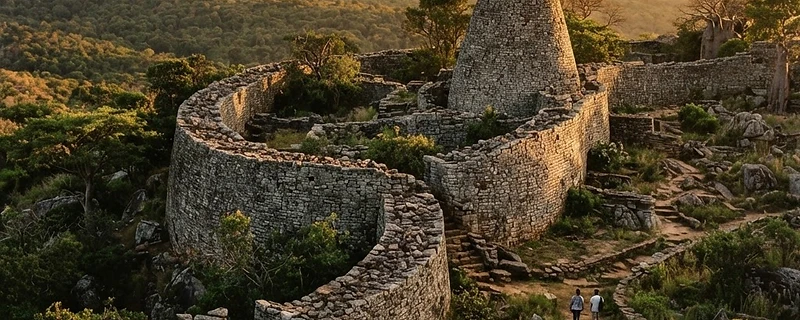
In the hills of Manica province lie the stone ruins of a civilization that rivaled Great Zimbabwe — built centuries before the Portuguese arrived. A history of Mozambique that begins long before 1498.
Stone Echoes of a Lost Empire
In the hills of Manica province, near the border with Zimbabwe, lie the ruins of a civilization that most Mozambicans have never heard of. Stone walls — some intact, some crumbling — extend across hilltops and valleys, forming enclosures, passages, and terraces that were built centuries before the Portuguese arrived. They are the Manica Ruins, and they are part of the same cultural complex that produced Great Zimbabwe — the greatest stone city in sub-Saharan Africa.
If you visit the Manica highlands, you can walk among these ruins, touch walls that were built by hands that have been dust for five hundred years, and contemplate a history of Mozambique that begins long before 1498.
The Zimbabwe Culture
The "Zimbabwe culture" (the word dzimba-dza-mabwe means "houses of stone" in Shona) flourished across the Zimbabwe plateau and adjacent areas of Mozambique from approximately 1200 to 1700 CE. At its center was Great Zimbabwe — a city of stone enclosures that housed up to 18,000 people, traded gold and ivory with the Swahili coast, and was one of the most powerful political centers in southern Africa.
Great Zimbabwe was not alone. The culture produced dozens of smaller stone settlements scattered across the region — in Zimbabwe, Mozambique, and Botswana. The Manica Ruins are among the most important of these satellite settlements.
The Manica Ruins
The ruins are located in several sites around Manica province, particularly near the town of Manica and in the Penhalonga valley. They include:
Niamara Ruins
The most extensive site, featuring stone walls up to 3 metres high, circular enclosures, and what appears to be a chevron-patterned wall decoration similar to that found at Great Zimbabwe. The site sits on a hilltop with commanding views of the surrounding valley.
Manyanga (Sipolilo) Ruins
Located near the border, this site features terraced stone platforms and evidence of gold-smelting activity — suggesting it was part of the gold trade network that connected the interior to the Swahili coast.
Rock Art Sites
The Chimanimani mountains and Manica highlands contain numerous rock painting sites — some dating back thousands of years before the stone ruins — depicting animals, hunting scenes, and spiritual symbols created by San and Khoekhoe peoples.
A Trading Network
The Manica Ruins were not isolated settlements. They were nodes in a vast trading network that connected the gold-rich highlands of the interior to the Swahili trading posts on the coast at Sofala (near modern Beira). Gold, ivory, and animal skins flowed eastward; cloth, beads, and ceramics flowed westward.
The Portuguese would later call this the Rota do Ouro — the Gold Route — and their desire to control it would drive the colonization of central Mozambique. But long before the Portuguese, the trade was controlled by African kingdoms — the Mutapa state, the Torwa state, and their predecessors — who built the stone settlements as administrative centers, ritual spaces, and symbols of power.
What Happened?
The Zimbabwe culture declined for reasons that are still debated by archaeologists. Environmental degradation (overgrazing, deforestation), climate change, political fragmentation, and the shift of trade routes northward all likely contributed. By the time the Portuguese arrived in the 16th century, the great stone cities were already in decline or abandoned.
The people did not disappear. They dispersed, merged with other groups, and continued to live in the region — as the Shona, Ndau, and Tewe peoples of modern Manica province. The stone walls remained, slowly being reclaimed by vegetation, standing as silent witnesses to a civilization that once rivaled anything in Europe.
Visiting the Ruins
The Manica Ruins are not well-developed for tourism. There are no visitor centers, no guided walkways, no interpretive signage. This is both their challenge and their charm.
- Access: From Chimoio, drive to Manica town (1 hour), then hire a local guide to reach the Niamara ruins.
- Guides: Essential — the ruins are unmarked and scattered. Ask at CAST Mozambique (listed on nendeni.com) for guide referrals.
- Best season: May to September (dry, cooler, less vegetation obscuring the walls).
- What to bring: Walking shoes, water, hat, and respect — these are sacred sites to many local people.
- Photography: Ask before photographing any ritual objects or rock art.
Why It Matters
The Manica Ruins matter because they disrupt a narrative. The narrative says that Africa had no civilization before European contact — no cities, no architecture, no trade networks. The ruins say otherwise. They say that in the hills of Manica, five hundred years before Vasco da Gama rounded the Cape, people were building stone cities, smelting gold, trading with the Swahili coast, and creating art that still speaks across the centuries.
When you stand among these walls, you are not visiting ruins. You are visiting a memory — a memory of what Africa was, and a reminder of what it can be again.
Find cultural experiences and hiking guides in Manica at nendeni.com.