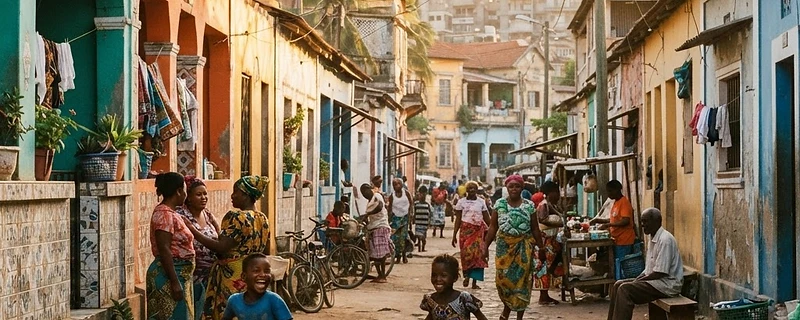
In Maputo's oldest informal settlement, community-led heritage tours reveal the neighbourhood that birthed marrabenta music, Negritude poetry, and the liberation movement itself.
Mafalala: The Neighbourhood That Refused to Be Forgotten
In the northeast corner of Maputo, wedged between the airport and the industrial zone, lies Mafalala — one of the city's oldest informal settlements. It has no stone buildings, no grand avenues, no monuments. But Mafalala is where Mozambican culture was forged.
A Suburb Born of Exclusion
Under Portuguese colonial rule, Africans were forbidden from living in the "cement city" — the European quarter of Lourenço Marques (now Maputo). They were pushed into peripheral subúrbios of reed and zinc: Mafalala, Polana, Sommerschield, and others. Mafalala, established in the early 20th century, became one of the most densely populated.
What the colonial authorities did not anticipate was that by concentrating people from across Mozambique — Makonde, Makhuwa, Tsonga, Chopi, Sena — in one place, they created a crucible of cultural fusion. Languages mixed. Musicians traded ideas. Dances cross-pollinated. Out of this forced proximity came something the colonisers never intended: a unified Mozambican cultural identity.
The Birthplace of Marrabenta
Marrabenta — Mozambique's most iconic musical genre — was born in Mafalala. The name comes from the Portuguese arrancar (to tear or rip), reflecting the raw, energetic guitar style that fused traditional rhythms with influences from South African kwela, Congolese rumba, and Portuguese folk music.
Artists like Fany Pfumo, Dilon Djindji, and the legendary group Ghorwane emerged from these streets. Their music carried coded messages of resistance during the liberation struggle, then became the soundtrack of independence after 1975.
The Mafalala Museum
In 2013, a group of residents — led by local historian João Mendes — established the Mafalala Museum in a small house in the neighbourhood. It is not a grand institution. It is a living archive: photographs of neighbourhood life from the 1940s onward, instruments, oral history recordings, and the stories of the neighbourhood's famous sons and daughters.
Among those remembered:
- Noémia de Sousa — The first Mozambican female poet, a foundational voice of Negritude in Mozambique. Born in Mafalala, her poem "Sangari" remains an anthem of African identity.
- José Craveirinha — Mozambique's greatest poet, whose work documented the life and struggle of his people. Winner of the 1991 Camões Prize.
- Eduardo Mondlane — Founder of FRELIMO, the liberation movement. Lived in Mafalala before studying abroad.
The Mafalala Walking Tour
Community-guided tours of the neighbourhood take visitors through:
- The Mafalala Museum and its oral history archive
- The house where José Craveirinha lived and wrote
- Community spaces where marrabenta is still played live
- Street art depicting neighbourhood heroes and historical events
- Local artisans and cooks who share their work with visitors
The tours are led by young people from Mafalala, trained in heritage interpretation. Revenue stays in the community — funding the museum, a children's library, and cultural workshops.
Why It Matters
Mafalala is not a tourist attraction in the conventional sense. There are no gift shops selling polished crafts, no air-conditioned cafés. What there is — in abundance — is truth. The story of Mozambique, from colonial oppression through liberation to the present day, is written in these narrow streets. A visit to Mafalala is not about observing poverty. It is about witnessing resilience, creativity, and the refusal of a community to let its history be erased.
"Mafalala is not a place you visit. It is a place that visits you."