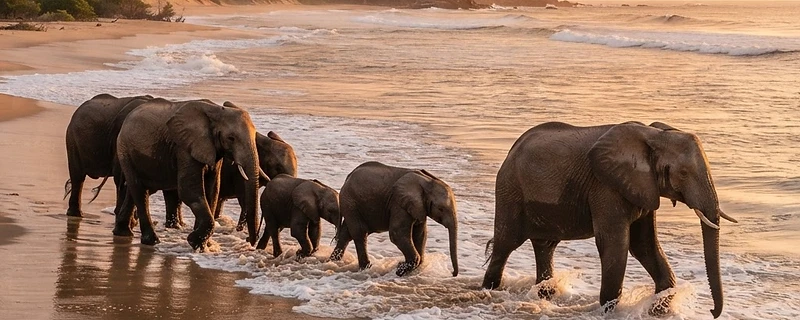
In Maputo Special Reserve, elephants walk from the bush to the beach — the only place in Africa where this happens. 400-500 elephants, community guides, and a luxury eco-lodge where elephants walk past your tent.
Where Elephants Walk on the Beach
In Maputo Special Reserve, in the far south of Mozambique, there is a phenomenon that exists nowhere else on Earth: elephants that walk from the bush to the beach, leaving tracks in the sand alongside human footprints.
This is one of the most extraordinary wildlife encounters available to travelers — and almost nobody knows about it.
The Reserve
Maputo Special Reserve (formerly Maputo Elephant Reserve) covers 1,040 km² of coastal bush, wetlands, and lakes in southern Maputo Province. It borders South Africa's Tembe Elephant Park and the Futi River Corridor, forming part of the Lubombo Transfrontier Conservation Area.
The reserve was established in 1932 to protect the local elephant population, which had been devastated by hunting. Today, the population is recovering — there are approximately 400-500 elephants in the reserve and the connected corridor.
The Elephants
The elephants of Maputo Special Reserve are special. Unlike most elephant populations, which avoid human settlements, these elephants have learned to coexist with the coastal communities. They migrate seasonally between the inland bush and the coast, following ancient routes that predate any human settlement.
When they reach the coast, they walk on the beach. They swim in the Indian Ocean. They eat coastal vegetation. There is no other place in Africa where you can see elephants on a beach.
What Else You'll See
- Coastal lakes: The reserve has several freshwater lakes where hippopotamuses, crocodiles, and waterbirds congregate.
- Wildlife: Besides elephants, there are leopards (rare), antelope (red duiker, reedbuck, suni), and over 300 bird species.
- Marine life: The reserve's coastline includes pristine beaches, coral reefs, and nesting sea turtles (October–March).
- Botanical diversity: The reserve sits at the transition zone between tropical and subtropical ecosystems, creating unusual plant diversity.
How to Visit
Community Guides (listed on nendeni.com)
Community guides from villages bordering the reserve lead 4x4 game drives and walking safaris. They know the elephant movements, the tracks, and the secret spots. 85% community benefit.
Anvil Bay Eco-Lodge (listed on nendeni.com)
The only lodge inside the reserve. Luxury tented accommodation on a wild beach. Elephants walk past the tents. $400-600/night. 50% community benefit.
Self-Drive
The reserve is accessible by 4x4 from Maputo (3 hours on reasonable roads, then sand tracks). Entry permit required. A community guide is recommended — the tracks are unmarked.
Best Time to Go
- June–September: Dry season. Elephants move toward the coast. Cooler temperatures. Best visibility.
- October–December: Hot. Elephants near water sources. Turtle nesting on beaches.
- January–March: Rainy season. Some roads impassable. But lush, green, and beautiful.
- April–May: Transitional. Fewer visitors. Good wildlife viewing.
The Threat
Maputo Special Reserve faces pressure from:
- Mining: Heavy mineral sands mining on the coast threatens elephant habitat and migration routes.
- Human-wildlife conflict: As communities grow, elephants and people increasingly come into contact — sometimes destructively.
- Fencing: South Africa's border fence blocks historical migration routes, isolating the elephant population.
- Poaching: Ivory poaching continues, though community ranger programmes are helping.
The community conservation initiatives listed on nendeni.com — including the Futi River Corridor Conservation project — are working to keep these ancient migration routes open. When you visit, your tourism spending supports this work.
An Experience Like No Other
Standing on a beach in southern Mozambique, watching a herd of elephants emerge from the coastal bush and walk toward the surf, is one of the most surreal wildlife experiences on Earth. It is the meeting of two worlds — bush and ocean, wild and human, ancient and modern.
There is nothing else like it. Go see it before it changes.
Find community guides and eco-lodges in Maputo Special Reserve at nendeni.com.