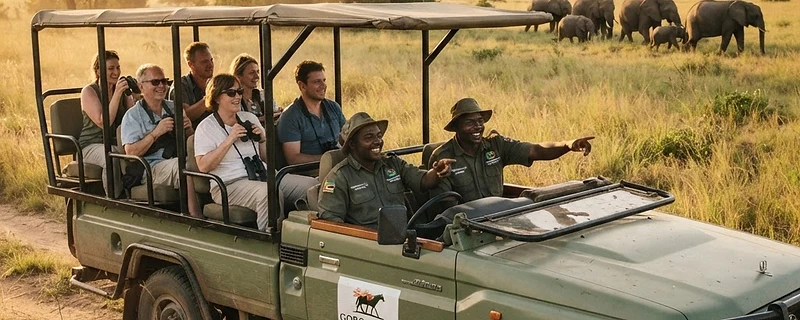
How to choose a safari that actually helps communities — not foreign hotel chains. The 6 questions to ask before booking, and Mozambique's ethical safari leaders with verified community benefit.
The Safari Dilemma
You want to go on safari. You want to see elephants, lions, and giraffes in the wild. But you also want your trip to actually help the people and animals you're visiting — not just line the pockets of a foreign-owned lodge chain.
The safari industry is full of "greenwashing" — marketing that implies ethical practices without delivering real community benefit. Here's how to tell the difference.
The Problem with Traditional Safaris
Most safaris in Africa follow a model that looks like this:
- A foreign-owned lodge charges $500-1,500/night
- The lodge employs local people as waiters, cleaners, and drivers (low-wage roles)
- Management and ownership are foreign
- A small percentage (if any) of revenue reaches the local community
- Wildlife is "protected" by armed rangers who keep local people OUT of their ancestral land
This model creates resentment, encourages poaching (as a form of resistance), and concentrates wealth in foreign hands. It is conservation that excludes people.
The Ethical Alternative: Community-Based Tourism
Ethical safaris follow a different model:
- The lodge or tour is owned (fully or partially) by the local community
- Local people are employed in management, guiding, and skilled roles — not just menial labor
- A significant percentage of revenue (look for 50%+) goes to community projects
- The community has a voice in how the wildlife is managed
- Conservation includes people, not excludes them
How to Tell if a Safari Is Actually Ethical
Ask these 6 questions before booking:
1. Who owns the lodge or tour company?
If the answer is "a European/American company" or "a multinational hotel group," the money is leaving Africa. Look for community-owned or at least locally-owned operators.
2. What percentage of revenue goes to the community?
If they can't answer this question, the answer is probably "not much." Look for operators who state their community benefit percentage clearly. On nendeni.com, every listing shows this number.
3. Are local people in management roles?
If every manager and guide is foreign, the operation is extracting value without building local capacity. Look for local guides, local managers, and training programmes.
4. Can you see the community projects?
If the operator claims community benefit but can't show you the school, clinic, or borehole they funded, be skeptical. Ethical operators are proud of their community projects and want you to see them.
5. Does the community have a voice?
Is there a community representative on the board? Are there regular community consultation meetings? If the community is not involved in decision-making, the "benefit" is charity, not empowerment.
6. Is the land community land?
In Mozambique, communities hold land under the DUAT (Direito de Uso e Aproveitamento da Terra) system. If the lodge sits on community land held under DUAT, the community has legal tenure and a stronger position.
Mozambique's Ethical Safari Leaders
Listed on nendeni.com with verified community benefit:
| Operator | Province | Community Benefit | Community-Owned | |---|---|---|---| | Covane Community Lodge | Gaza | 100% | ✅ | | Tchuma Tchato | Tete | 85% | ✅ | | Maputo Special Reserve Community Guides | Maputo | 85% | ✅ | | Marromeu Buffalo Reserve | Sofala | 80% | ✅ | | Banhine National Park Guides | Gaza | 90% | ✅ | | Búzi River Homestay | Sofala | 100% | ✅ |
These operators prove that community-based safaris are not a compromise — they're often a better experience. You get a community guide who grew up tracking wildlife, not a foreign guide who learned it from a textbook. You eat food cooked by local women, not imported hotel cuisine. You hear stories from people whose families have lived with these animals for generations.
The Ethical Safari Checklist
Before you book any safari in Africa, ask:
- [ ] Who owns this operation?
- [ ] What % goes to the community?
- [ ] Are locals in management?
- [ ] Can I see community projects?
- [ ] Does the community have a voice?
- [ ] Is the land community land?
If the answers are good, book it. If they're not, look for alternatives on nendeni.com.
The Bottom Line
An ethical safari costs the same — or less — than a conventional one. The difference is where the money goes. When you choose community-based tourism, you're not sacrificing comfort or wildlife viewing. You're gaining authenticity, connection, and the knowledge that your trip is building something rather than extracting from it.
That's the only kind of safari worth taking.
Find ethical safaris across Mozambique at nendeni.com.